WATAM DeFi Intelligence
Self-hosted on-chain analytics for DeFi teams

On-chain analytics your team can verify.

WATAM DeFi Intelligence collects a token's swaps directly from the blockchain, checks that the data is complete, and shows what happened pool by pool — with unusual activity flagged and the evidence attached. It runs on infrastructure you control, and every report states exactly which pools and hours it covers.

Your infrastructure. Your blockchain data. Verifiable intelligence. Deployed per customer — no shared hosted service — and pilots are scoped individually.

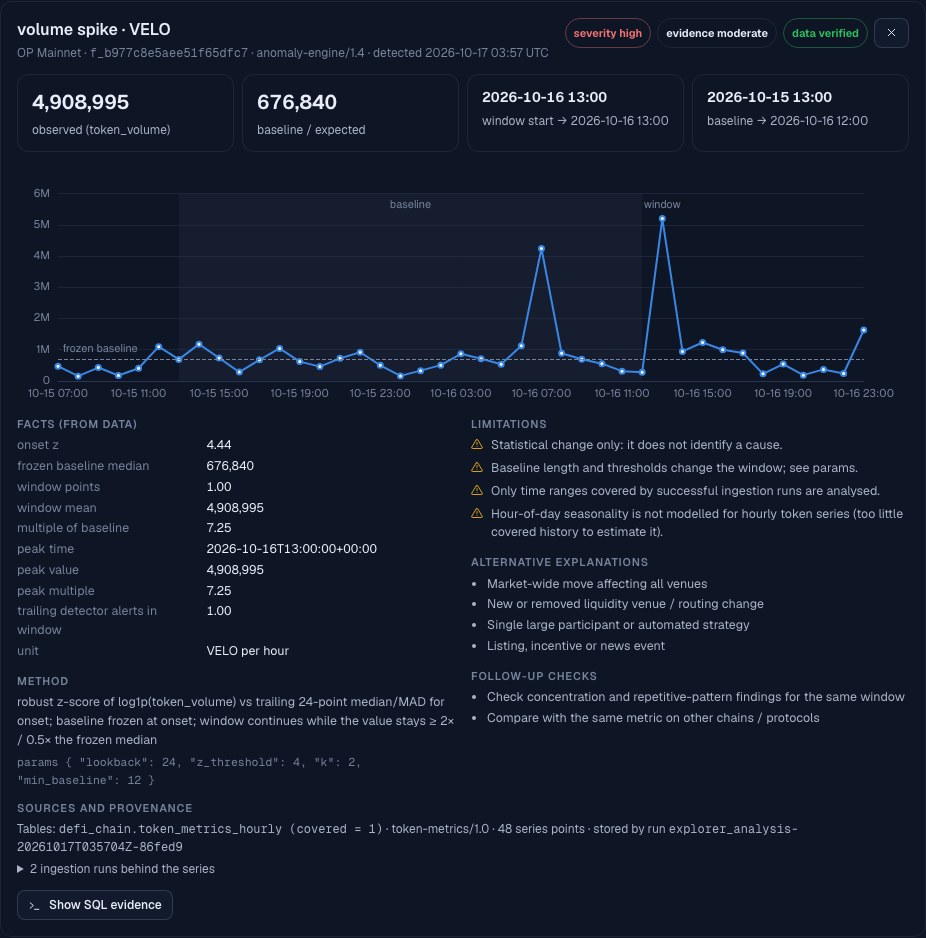
One anomaly finding for VELO on OP Mainnet: hourly token volume in VELO against a frozen baseline, with facts, method, limitations and provenance
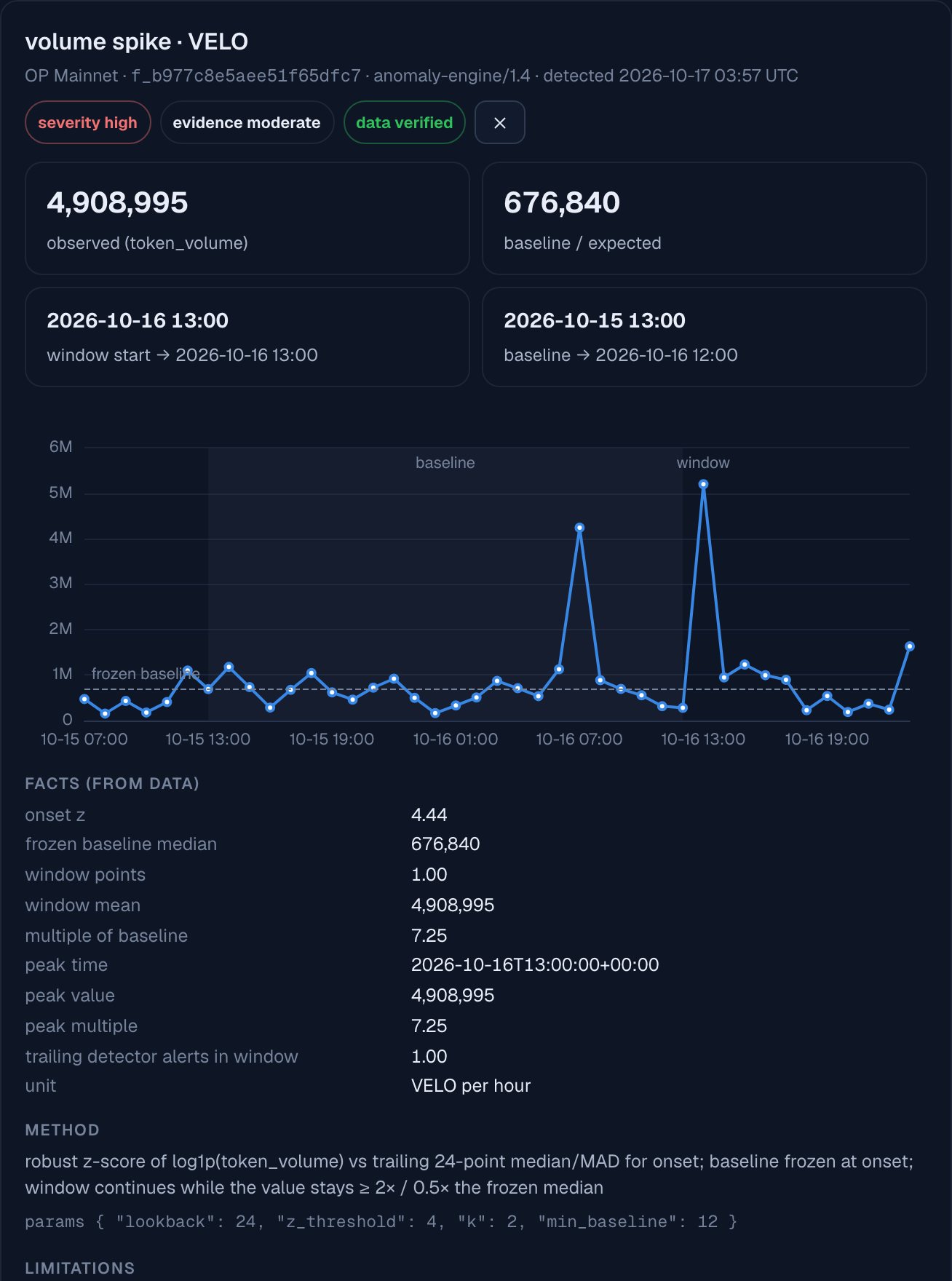
The same VELO finding as the web app lays it out in a tablet browser: headline figures in two columns above the hourly chart and the facts table
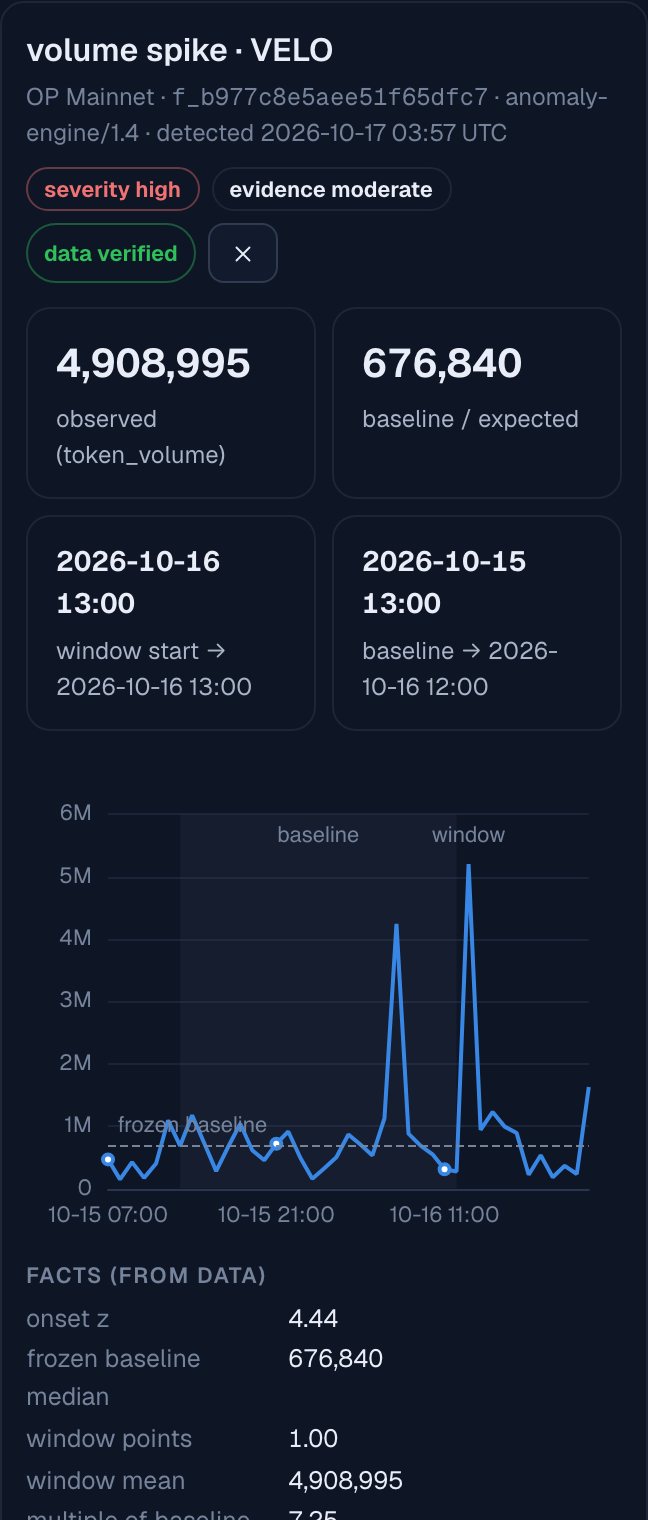
The same VELO finding in a phone browser: observed volume and baseline stacked above the hourly chart

Real screens from the self-hosted web application: the same VELO finding as the app lays it out in a desktop, tablet (820 px) and phone (390 px) browser. Behind them, the real hourly VELO volume on OP Mainnet for 15–16 Oct 2026, with the frozen baseline dashed and the two flagged spikes marked. Historical snapshot computed from swap events collected over public JSON-RPC — not live. It is a responsive web app, not a native app.

Built on receipt-verified data

Swaps are read from public JSON-RPC or your own endpoints, proven complete for every block range and cross-checked before anything is published. A protocol family is supported only after its decoded swaps matched transaction receipts exactly on several networks. Uniswap v4 is verified differently: its pools share one contract and can carry hooks, so each pool is verified on its own, and only individually verified pools are ingested.

Networks
BaseArbitrum OneOP MainnetEthereum
Verified protocol families
Uniswap v3-styleUniswap v2-styleSolidly (Velodrome/Aerodrome v2)
Individually verified pools
Uniswap v4: six Ethereum pools, each verified on its own
Not counted
PancakeSwap v3 (decoder only, not verified for ingestion)Other Uniswap v4 pools and networksv4 pools with native ETH or swap-changing hooksOther venues

For teams whose numbers have to hold up

Every figure carries its coverage, its valuation method and the SQL behind it, so analysis can be reproduced, reviewed and shared.

Protocols, DAOs and token teams

See how your token trades across chains and pools — volume, liquidity and valuation coverage — and get flagged when activity departs from its baseline.

Funds and research desks

Source-backed token and protocol research with stated coverage, so a conclusion can be traced back to the swaps that produced it.

Risk and market-integrity analytics

Anomaly findings for investigation triage: statistical observations with baselines, limitations and alternative explanations, never accusations.

Analytics consultancies

Client-ready reports from verified data on private infrastructure, with an AI analyst that answers in several languages without inventing numbers.

How it works

Three stages, each with its own checks. Nothing reaches a report or an AI answer without passing the stage before it.

  1. Verified data

    Ingestion runs prove block coverage, confirm empty answers with a second provider and publish to ClickHouse only after quality gates pass. USD comes from stablecoin legs or an hourly price feed configured for the installation; unvalued swaps are never counted as $0.

  2. Analytics and findings

    Covered-hour metrics, window comparisons and an anomaly engine with frozen baselines. Reports state exactly which pools and hours they cover.

  3. Evidence-grounded AI

    The AI phrases answers from the verified facts of each question. Every number must match a fact the sentence cites; anything unproven is replaced by a clearly labelled deterministic answer.

How it works — 3-minute walkthrough

The workflow end to end: verified data, a token report, an anomaly finding with its SQL evidence, a two-window comparison and the analyst.

The narration is an AI-generated voice. The screens come from a 20 Oct 2026 build with historical data. Captions are on by default.

What teams can do with it today

Three analytical tasks the current release supports on its verified networks and protocol families. Each one states what it covers and what it does not.

Analyse a token pool by pool

Token teams, protocol analytics, research desks

Paste a token contract. The application checks it on-chain, finds its pools and says which ones it can decode. It then collects the missing hours through the same gated pipeline and reports swaps, token volume, buyers and sellers, and routing per pool — with the covered hours stated.

Covers the selected pools on supported networks, not the token's whole market.

Triage unusual activity

Risk, market-integrity and research teams

The anomaly engine flags volume, activity and liquidity shifts against a baseline frozen at onset, plus concentration, imbalance and repetitive patterns. Every finding carries its facts, method, parameters, limitations and alternative explanations, so it can be checked before anyone acts on it.

A statistical observation, never a claim of intent or manipulation.

Compare two time windows

Growth, treasury and research teams

Compare a token's activity before and after a listing, an incentive change or an event. A comparison is marked comparable only when every pool is covered in both windows; otherwise the report says it is incomplete instead of showing a misleading change.

Historical windows that have been ingested; not live streaming.

An AI analyst that cites its sources

Ask in English, Turkish or German and keep the conversation going: follow-up questions keep the token and topic. Each answer is labelled either as a validated AI answer or as a deterministic answer built from the same verified facts.

Conversational analystIllustration of the answer format — not a live query

What happened to VELO volume on OP Mainnet on 16 October?

  • On 16 October the anomaly engine flagged three high-severity findings for VELO: token volume at 7.43× and 7.25× a baseline frozen at onset, and swap activity at 12.8×.F1F2F3
  • In the reviewed window, 16 Oct 12:00 to 17 Oct 00:00 UTC, the ingested pools recorded 65,568 Swap events in 12 of 12 covered hours, from 58,792 distinct transactions.F4F5
  • These figures cover the 6 ingested pools only, not VELO's whole market.F6
  • A statistical observation — not a claim of intent or manipulation.
F1
Token volume ÷ frozen baseline (anomaly finding)
7.43×
F2
Token volume ÷ frozen baseline (anomaly finding)
7.25×
F3
Swap activity ÷ frozen baseline (anomaly finding)
12.8×
F4
Pool Swap events in fully covered hours
65,568
F5
Distinct transactions
58,792
F6
Pools ingested by successful runs
6
Every number in an answer must match a fact the sentence cites. Figures from the reviewed VELO snapshot below.
Inference optionStatusNotes
Local models via OllamaTestedRuns on your hardware; a memory guard prevents overloading the host
Anthropic Claude APIIntegratedOptional and off by default; no paid call until an administrator authorises it within limits. Live calls not yet verified
OpenAI APIIntegratedSame controls as Claude. Live calls not yet verified
Self-hosted OpenAI-compatible serversIntegration optionvLLM, llama.cpp, LM Studio or an organisation gateway through the same adapter; GPU serving not yet tested

Local model benchmark

The same frozen fact set (10 questions in English, Turkish and German; 8 answered by the model, 2 declined by deterministic pre-checks) and the same validators, on a 16 GB machine.

ModelAccepted by validationGrounding failuresAvg latencyMemory
gemma3:4b8 / 808.3 s2.9 GB
qwen3.5:9b6 / 8222.4 s5.7 GB

In release testing on 2026-10-17, gemma3:4b answers to an English question and English and Turkish follow-ups were all accepted. In a later run a Turkish answer that cited the wrong facts was rejected and replaced by the deterministic answer — exactly what the validation is for. One machine, not a performance promise.

Verified research examples

Reviewed snapshots of historical windows from October 2026. Every figure here was recomputed before publication from swap events our own pipeline collected over public JSON-RPC. USD values are deliberately not shown: they depend on an external price feed. These examples illustrate the method; they are not live data and not a statement about any protocol.

Historical research snapshot

ARB on Arbitrum One

14 Oct 2026, 12:00 UTC to 17 Oct 2026, 08:00 UTC · 4 ingested Uniswap v3-style pools · reviewed snapshot, not live

Every Swap event emitted by the selected pools in this window, counted hour by hour. These are selected-pool event measurements: not the total ARB market and not transaction-net trading volume.

64,763
pool Swap events
64,564
distinct transactions
68 / 68
hours covered by successful, gated ingestion runs
0
duplicate events: each on-chain event is stored exactly once
93.33M
ARB in pool-event volume, from raw on-chain amounts
23,700
swaps with a stablecoin on the other side
4
pools; the fourth contributes 107 events, all after 17 Oct 04:00 UTC
1
anomaly finding under the current method: address concentration on 16 Oct, medium severity; none high

How to read these numbers

  • Selected pools, not the market. Only the four ingested pools are measured. Other pools, venues and centralised exchanges are not included.
  • Pool events, not net trades. A trade routed through two ingested pools is counted in both; transaction-net volume is reported separately in the application.
  • Historical. A reviewed snapshot of an ingested window, published as an example. Nothing on this page is live.

About USD values

  • Not shown here. In the application, USD comes from a stablecoin leg where one exists, otherwise from an hourly price feed configured for the installation.
  • Never zero-filled. A swap without a usable price stays unvalued and is counted as such, so coverage is visible instead of hidden.
The four ingested ARB pools and their Swap events in the window
PairProtocol family and poolFee tierSwap events
WETH / ARBUniswap v3-style 0xc6f7…396a0.05%40,956
ARB / USDCUniswap v3-style 0xcda5…dad80.05%18,586
ARB / USDCUniswap v3-style 0xaebd…ccc30.3%5,114
WETH / ARBUniswap v3-style 0x92c6…8f000.3%107
4 poolsreceipt-verified Uniswap v3-style decoder64,763
Historical research snapshot

VELO on OP Mainnet

16 Oct 2026, 12:00 UTC to 17 Oct 2026, 00:00 UTC · 12 pools discovered and verified, 6 ingested · reviewed snapshot, not live

An example of what the anomaly engine reports — and of what the data does not cover. Market coverage is partial and the report says so. USD values are not shown (see above).

12
candidate pools, each verified on-chain and classified as supported
6
pools ingested (3 Solidly-style, 3 Uniswap v3-style)
65,568
pool Swap events in 12 of 12 covered hours
12.68M
VELO in pool-event volume
62,302
Solidly-style events carrying 463,647 VELO
3,266
Uniswap v3-style events carrying 12.2M VELO
58,792
distinct transactions; 0 duplicate events
3
high-severity findings from swap counts and token volume: spikes of 7.25×, 7.43× and 12.8× against a frozen baseline
A VELO volume spike finding: chart with frozen baseline and observation window, facts, method, limitations, alternative explanations and provenance
One finding with its facts, method, limitations, alternative explanations and provenance.

What a finding is — and is not

  • A statistical observation. A metric moved far from a baseline frozen at onset. The finding states the method, parameters and the data it used.
  • Never an accusation. It does not establish intent, manipulation or wash trading, and addresses are not identified entities.
  • Alternatives stated up front. Market-wide moves, new liquidity venues, a single large participant or a listing can each explain a spike.
  • Coverage is explicit. Only hours covered by successful ingestion runs are analysed; partial market coverage is reported, not hidden.

What's verified, and what isn't yet

We separate what has been tested on real data from what is integrated, experimental or not supported. "Reference installation" means our own deployment; every customer installation verifies its own backups and recovery.

CapabilityStatus
Ingestion, token explorer, anomaly engine, reports and window comparisons on Base, Arbitrum One, OP Mainnet and EthereumTested on real data
Uniswap v3-style, Uniswap v2-style and Solidly-style decoders (decoded swaps matched transaction receipts exactly)Tested on real data
Uniswap v4: six individually verified Ethereum pools (PoolId/PoolKey match, two-provider agreement, sampled receipt reconciliation)Tested on real data
Access control: every API route requires sign-in by default, organisation roles, personal API tokens, single-use invitations for onboardingTested and in production use
Sandboxed query engine: file, network and extension access blocked at validation and at executionTested and in production use
Encrypted off-site backup to Cloudflare R2, restore-verified on a separate isolated serverVerified on our reference installation (Oct 2026)
Local models via Ollama, including a multilingual multi-turn conversationTested on one machine
Self-hosted Docker Compose installation: TLS proxy, first administrator, your own RPC endpoints, upgrade and rollbackTested on Docker Desktop
Kubernetes deploymentValidated on a local single-node cluster
PancakeSwap pools, Solana research, one-click token analysisExperimental
Anthropic Claude API and OpenAI API (optional, off by default, your own account)Integrated, live calls not yet verified
Dune (optional, off by default, your own account)Integrated, not verified live
vLLM and GPU inference serversNot yet verified
Other Uniswap v4 pools, other networks, hooks that change swap amounts, native ETHNot supported
Hosted multi-tenant SaaSNot offered

Deploy it on your own infrastructure

Only the TLS proxy is exposed. ClickHouse, pipelines and inference stay on internal networks, and secrets are encrypted at rest.

ProfileStatusTargetNotes
Business serverTested on Docker DesktopLinux with Docker Compose, 32 GB RAM recommended, 50 GB+ persistent storage, optional NVIDIA GPURead-only preflight installer, first-administrator setup, upgrade and rollback by release tag. Not yet installed on a customer server
Local evaluationTestedA 16 GB machineSmall local models, memory guard, automatic ingestion off by default
EnterpriseValidated locallyKubernetes, separate GPU inference serversKubernetes manifests with optional Airflow. Upgrade, rollback, persistence, network policies and backups validated on a local single-node cluster; production clusters, managed cloud, external TLS ingress and GPU inference nodes not yet validated

Backups are encrypted before they leave the server, and the key stays with you. Point them at your own S3-compatible bucket for off-site copies; each backup can be restore-verified on a separate, isolated server without modifying production data. On our reference installation an encrypted backup to Cloudflare R2 and its isolated restore were verified end to end in October 2026; each customer installation runs its own backup and restore verification.

Starting points, not performance promises: capacity depends on the measured hardware.

Let's scope a private pilot

Tell us which tokens, protocols and networks matter to you. The first step is a discovery conversation; if it fits, we agree a fixed, measurable pilot scope in writing before anything is installed.

Opens a short email template: organisation, contact, what you want to analyse, preferred deployment and AI. Or write to

  • The first conversation covers

    Your analytical questions; the chains, tokens, pools and data sources involved; deployment and data-handling constraints; integrations you need; and the current limitations that apply to your case.

  • You provide

    A Linux server with Docker (32 GB RAM recommended, 50 GB+ storage), optionally your own RPC endpoints and a local or cloud AI model.

  • We never ask for

    Confidential datasets, API credentials, private keys or passwords — not by email and not during the pilot.

  • Before anything is deployed

    Pilot scope, deployment feasibility, data-source permissions, licensing and commercial terms are agreed in writing. A first conversation is not a commitment on either side.

Limitations

Stated plainly, so you know what the numbers cover.

  • Only the listed networks, verified protocol families and individually verified pools are analysed, and only pools that were discovered and ingested. Other venues are not counted, so no figure on this page is a token's whole market.
  • Pool-event volume counts a routed trade in every ingested pool it passes through. Transaction-net volume is reported separately.
  • The examples on this page cover historical, ingested windows. Nothing here is live, and the page connects to no API.
  • AI answer quality depends on the model. Validators reject ungrounded or forbidden statements but do not correct grammar.
  • Dune and cloud AI integrations are optional and off by default.
  • Off-site backups need an external S3-compatible destination configured per installation; until one is registered and verified, they are reported as not configured. Recovery was verified on our reference installation, not on every customer environment.
  • WATAM DeFi Intelligence is installed per customer on their own infrastructure. A hosted, multi-tenant SaaS service is not offered.
  • The research examples use public blockchain data collected by the application; USD values are omitted because they depend on an external price feed. Protocol, token and network names describe the data analysed; they do not imply any affiliation or endorsement.
  • WATAM DeFi Intelligence is analytics and research software. It is not investment advice, makes no promise of trading or investment outcomes, and is not a regulatory certification.